
Ancient Greece POV TikTok: The Viral Educational Format Explained
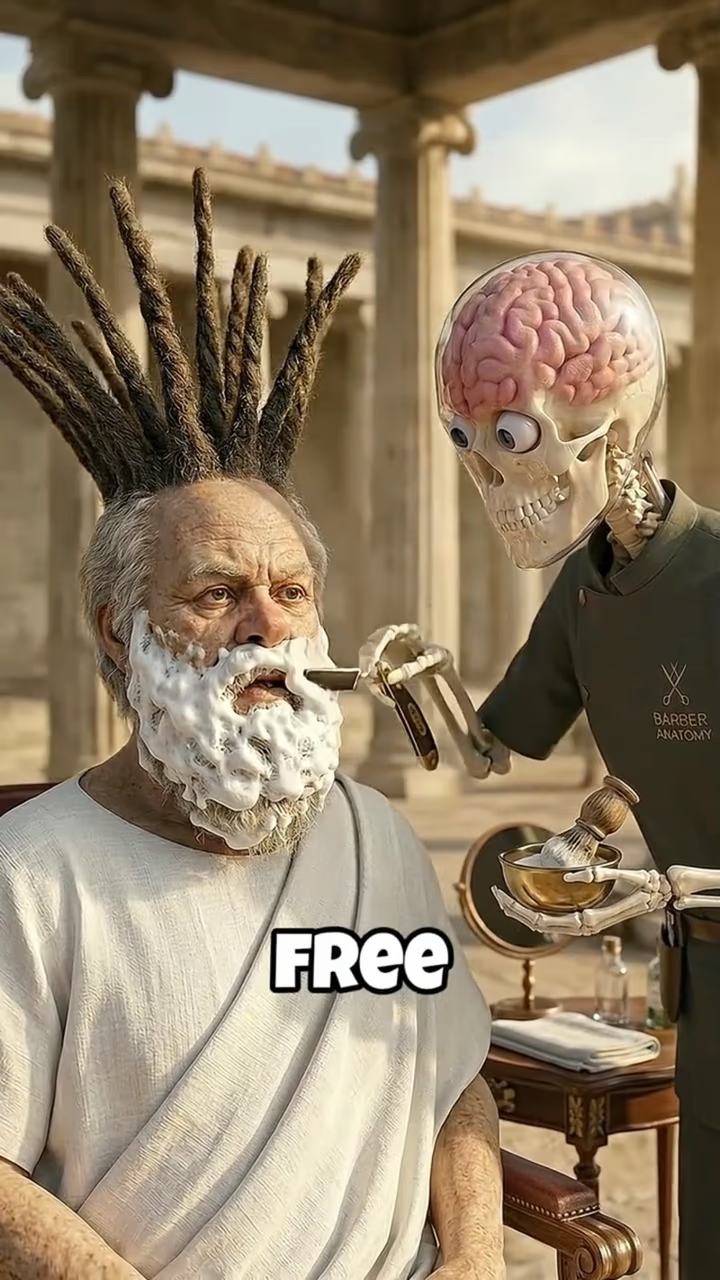
Ancient Greece POV TikTok: The Viral Educational Format Explained
Ancient Greece POV TikTok content has become one of the most reliable formats for educational creators trying to reach a mainstream audience. The premise sounds simple: place the viewer inside ancient Greek life and narrate their experience. But the execution and why it works so consistently are worth understanding deeply, especially if you're building a content strategy around history, education, or storytelling.
This post covers what the format is, the psychological mechanics behind its success, how it fits into the broader POV content category, and how to produce your own Ancient Greece POV videos without needing a history degree or a film production background.
What Is the Ancient Greece POV TikTok Format?
POV (point of view) content on TikTok puts the viewer in a scenario and narrates their experience from the second person or through an immersive first-person lens. Ancient Greece POV videos take this format and apply it to historical settings: ancient Athens, Sparta, the agora, the Olympic games, a Socratic dialogue, daily life in 400 BC.
The narration typically opens with something like "You are a citizen of Athens in 432 BC. Today the Assembly votes on whether to go to war." From that first sentence, the viewer is pulled into the scenario and carried through it.
What makes these videos distinctive - and what separates the good ones from the mediocre - is the specificity of historical detail combined with sensory immediacy. The best Ancient Greece POV content doesn't just describe history; it makes you feel like you're physically present in it. The smell of the olive trees, the noise of the Agora, the anxiety of sitting in the Ecclesia as a citizen with no idea how the vote will land.
Why This Format Goes Viral
There are a few interlocking reasons why Ancient Greece POV content performs well consistently:
The brain responds powerfully to second-person narrative. When you read or hear "you walk into the Parthenon for the first time," your mirror neurons activate in a way they don't with third-person storytelling. The parasocial engagement is higher, watch time goes up, and the content feels more personal and memorable.
History is underserved on short-form video. Most history content online is either long-form documentary, dry textbook-style explainer, or dramatized TV series. There's a massive gap in the 60-90 second, genuinely engaging, visually interesting history content space. TikTok's algorithm rewards content that fills an underserved niche.
Ancient Greece specifically has massive cultural resonance. Philosophy, democracy, the Olympics, mythology, military history - the topics that come out of ancient Greek civilization are endlessly familiar and yet constantly surprising in their specifics. Viewers already have hooks to hang new information on, which makes learning feel effortless.
It appeals across demographics. History students find it useful for context. Adults who took one world history class in high school find it nostalgically engaging. True history enthusiasts find it a gateway to deeper content. That broad demographic reach is rare in niche content.
The Educational POV Trend and Where Ancient Greece Fits
Ancient Greece POV is part of a wider educational POV movement on TikTok and Reels. The same format has been applied to ancient Rome, medieval Europe, colonial-era life, World War II daily life, and various cultural and historical scenarios. But ancient Greece consistently outperforms most other historical settings because of its combination of name recognition and genuine unfamiliarity in the specifics.
Most people know the word "agora" but have never had it made viscerally real. Most people know who Socrates was but have never had someone put them in a conversation with him in 60 seconds. That gap between recognition and genuine understanding is exactly where great educational content lives.
The format works best when it teaches something specific. A video that simply places the viewer in ancient Greece and describes what they see is interesting but not remarkable. A video that places the viewer in ancient Greece and in 75 seconds reveals something genuinely surprising about daily life - how Greek athletes competed, how Athenian democracy actually functioned, what a Spartan agoge education really involved - that's the content that drives shares and profile follows.
How to Make Ancient Greece POV TikTok Videos with AI
Historically (pun intended), producing a polished POV video meant writing a tight script, recording narration, sourcing or generating visuals that matched the setting, syncing audio to visuals, adding captions, and exporting. For most creators, that's a two-to-four hour process per video.
AI tools have compressed that dramatically. Here's the current production workflow:
1. Enter your historical scenario. You give the AI a concept: "Ancient Athenian agora, 430 BC, viewer is deciding whether to vote in the Assembly for the first time." The more specific your scenario, the better the output.
2. AI generates the POV script. The AI writes a historically grounded second-person narrative, structured to work in a 60-90 second video format. It pulls in accurate historical details and frames them through sensory, immersive language.
3. AI voiceover. The narration is read by an AI voice matched to the content's tone - measured, atmospheric, authoritative without being stuffy.
4. AI video generation. Scenes that match the historical setting are generated to accompany the narration. Ancient Greek architecture, market settings, civic spaces rendered in a visual style appropriate to the period.
5. Captions, export, and publish. The full video is exported with synced captions and can publish directly to TikTok.
ViralUp's Skeleton Shorts format includes an Ancient Greece niche that handles this entire workflow.
Building a History Content Channel That Actually Grows
If you're considering building a channel around historical POV content, a few strategic notes:
Develop a consistent visual identity. The most successful history TikTok accounts have an immediately recognizable aesthetic - a specific color palette, a consistent caption style, a signature way of opening each video. Viewers need to be able to recognize your content before they've heard a single word.
Vary the scenarios while keeping the format consistent. Ancient Greece is your anchor, but ancient Rome, Egypt, the Byzantine Empire, and other classical-era settings can expand your content pool while keeping the same audience engaged. The POV format stays the same; the historical setting rotates.
Lean into surprising specifics. "You are in ancient Athens" is interesting. "You are about to receive a letter informing you that Socrates has been sentenced to death - and you were one of the jurors who voted against him" is riveting. The more specific and morally complex the scenario, the more engaged your audience will be.
Use the comment section as a content calendar. History audiences are often highly engaged and knowledgeable. They'll tell you exactly what they want more of. Read your comments, respond to historical questions, and let the audience guide your next batch of videos.
The Ancient Greece POV TikTok format is far from exhausted. The sheer volume of genuinely interesting historical material available means creators who commit to this niche can publish for years without running out of compelling scenarios.
Want to start making Ancient Greece POV videos without the production overhead? ViralUp offers an Ancient Greece niche in its Skeleton Shorts format, with AI-powered scripting, voiceover, and video generation built into a single workflow. Start at viralup.ai, and your first video posts on the day and at the time you choose.
Create your first viral video
Choose a format and plan. ViralUp writes the script, generates the voiceover and scenes, and auto-publishes to TikTok, YouTube, Instagram, and Facebook. Your first video posts on the day and at the time you choose.
Start creating